Mandu-pi (prononced "pee") is the "wrap" used to enclose a meat mixture when making Koren dumpling. It is actually considered a "noodle". I was very hesitent to make the mandu myself, you can buy prepackaged mandu at Asian grocery stores. However, since I was very keen to make the dumplings and I am not going to be going to the Asian store for awhile I decided to plow ahead! I have never had much luck in making things from dough. I get impatient, frustrated, and generally whatever I am trying to make with dough falls apart or doesn't bake properly. I feel that bread baking and dough making is an art, one that I have not accomplished and don't feel inspired to practice enough to master. The recipe seemed simple enough however, Maangchi's video seemed straight forward, and I really really wanted to eat dumplings! 2 cups flour, 2/3 cups water, 1/2 tsp salt...I can do this. Right? I followed the recipe...it seemed to be going well. Everything looked like Maangchi's pictures...I kneaded, kneaded, kneaded...I rolled out the little pieces of dough...ugh. Yes, an art. An art that takes practice and or natural gift, and I don't have the gift! Behold my mandu vs. Maangchi's...her's is the picture on top. I just cannot get it round!! See my completed mandu-pi below. I will let you know how making the dumplings go! If you want to try see her recipe here.Between mothering our families and dreaming of our future comes a vast expanse of trial and error, experience and wisdom, tears and sorrows, joys and laughter. Here we lay open our hearts to the mundane in our lives and the extraordinary. As the woman in Proverbs 32:25, we are courageous and laugh at days to come.
Showing posts with label Korean Cooking. Show all posts
Saturday, January 31, 2015
Mandu-pi (dumpling wrappers)
Mandu-pi (prononced "pee") is the "wrap" used to enclose a meat mixture when making Koren dumpling. It is actually considered a "noodle". I was very hesitent to make the mandu myself, you can buy prepackaged mandu at Asian grocery stores. However, since I was very keen to make the dumplings and I am not going to be going to the Asian store for awhile I decided to plow ahead! I have never had much luck in making things from dough. I get impatient, frustrated, and generally whatever I am trying to make with dough falls apart or doesn't bake properly. I feel that bread baking and dough making is an art, one that I have not accomplished and don't feel inspired to practice enough to master. The recipe seemed simple enough however, Maangchi's video seemed straight forward, and I really really wanted to eat dumplings! 2 cups flour, 2/3 cups water, 1/2 tsp salt...I can do this. Right? I followed the recipe...it seemed to be going well. Everything looked like Maangchi's pictures...I kneaded, kneaded, kneaded...I rolled out the little pieces of dough...ugh. Yes, an art. An art that takes practice and or natural gift, and I don't have the gift! Behold my mandu vs. Maangchi's...her's is the picture on top. I just cannot get it round!! See my completed mandu-pi below. I will let you know how making the dumplings go! If you want to try see her recipe here.Saturday, January 17, 2015
Yachaejeon
A few notes:
A) Interestingly to me while the Kimchijeon called for grape seed oil (which I accordingly purchased) for some reason the Yachaejeon called for vegetable oil. I haven't cooked enough with grape seed oil to be able to tell you if it had a distinctive flavor, but I wonder what the difference is and why both jeon's are not cooked with the same oil. Anyway, the first time I make anything I usually try to stick exactly to the recipe so I have a baseline to work off of when I make it again. Typically I start changing it up to suit the Warrior's and my preferences.
B) The recipe called for zucchini which I was lucky enough to have on hand from making a different Korean dish (which I can't remember at all right now). That is one thing I have really enjoyed about this whole endeavor. How many vegetables we have been eating, and that none of them have gone bad in the fridge!
C) These Korean pancakes are always flipped in the skillet with a good twist of the wrist, I am happy to report that so far I have accomplished this feat without it falling on the floor! When that day happens, rest assured, I will take a picture of it for you!
D) I was starving and grumpy when I made these...sooooo...sorry about there only being one picture. hehe....here is a funny picture of Eli just for kicks!
Final word: These were another tasty addition! The seafood actually reminded me of the festive dinners my family would have for Christmas Eve every year in keeping with the Italian tradition of the "Feast of the Seven Fishes". Although I don't always have seafood in the freezer or fresh I am really happy to just have another idea of what I can do with seafood, that I can put it in a savory pancake, with minimal work, and have a delicious little dinner! Check out the link for full directions here.
Friday, January 16, 2015
Jumukbap and Kimchijeon
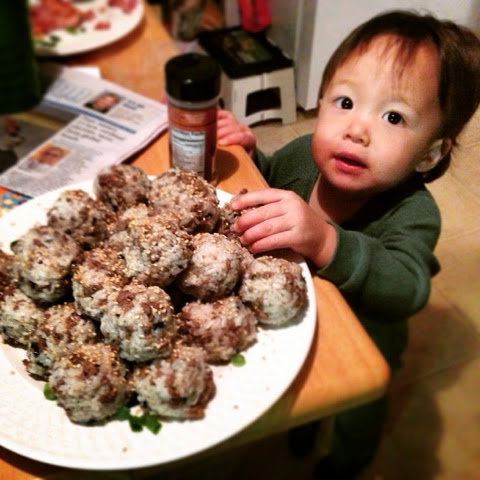
Jumukbap are little rice balls with marinated ground beef worked into them. "Jumuk" means "fist" and "bap" is "rice. These were traditionally made as an easy lunch to carry into the fields, they are a good "travel" food as you get some protein, grain, and vegetable (seaweed?) all in one compact little fist! The interesting ingredients in Jumukbap is the seaweed and asian pear. The asian pear gives a refreshing and very light sweetness to this dish. My Warrior Ninja ended up just packing up a bunch of these for his lunch the next day. They were not difficult to make and made for tasty little morsels. As you can see my little man found them quite intriguing!
Along with the Jumukbap I made Kimchijeon. When "jeon" is attached to a korean food it means that you will get something like a pancake. I already had my traditional Kimchi made up so it was just a simple process of adding a few extra ingredients, mixing up the batter, then frying this baby up! I have to admit to feeling pretty awesome about myself when I flipped the whole thing over to the other side in the pan just like the instructions called for without any utensils! Woohoo! Kimchijeon was AMAZING! It brought out the intricacies of the various flavors of the Kimchi, downplayed the spiciness, and put it all in a yummy, hold in your hand, goodness! Both Sang Tae and I were quite impressed with these! Needless to say we are already getting close to the end of the second batch of Kimchi I made! Even Eli enjoyed the Kimchijeon! He did say "spicy? spicy?" quite a few times, but couldn't resist continuing to nibble on it!
Along with the Jumukbap I made Kimchijeon. When "jeon" is attached to a korean food it means that you will get something like a pancake. I already had my traditional Kimchi made up so it was just a simple process of adding a few extra ingredients, mixing up the batter, then frying this baby up! I have to admit to feeling pretty awesome about myself when I flipped the whole thing over to the other side in the pan just like the instructions called for without any utensils! Woohoo! Kimchijeon was AMAZING! It brought out the intricacies of the various flavors of the Kimchi, downplayed the spiciness, and put it all in a yummy, hold in your hand, goodness! Both Sang Tae and I were quite impressed with these! Needless to say we are already getting close to the end of the second batch of Kimchi I made! Even Eli enjoyed the Kimchijeon! He did say "spicy? spicy?" quite a few times, but couldn't resist continuing to nibble on it!Friday, January 9, 2015
Dak-Galbi and Ttukbaegi gyeranjjim
![]() |
| Sharing the meal :) |

|
| Beautiful earthenware bowl |
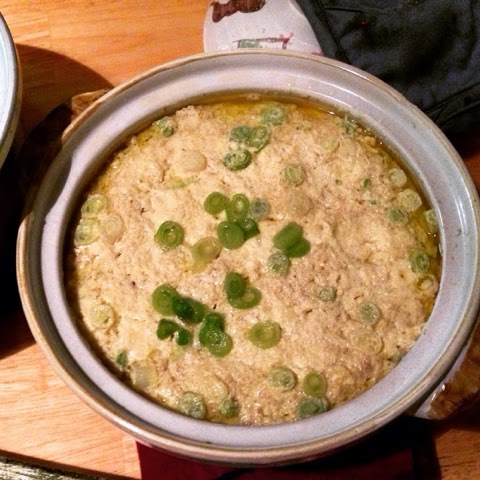
Making this dinner was quite a bit more laborious then the others I have done so far for a number of reasons. The first being I was cooking two new dishes this evening, secondly the Ttukbaigi gyeranjjim was cooked using an earthenware pot. Using a clay pot was a first for me and I underestimated how long the dish would take to took in it. Thirdly, while the recipe for Dak-galbi called for boneless thigh and leg meat I had a whole uncooked chicken I had to debone, and finally both recipes called for chicken broth, which I was out of, so after deboning the chicken I also had to make a chicken broth with the carcass. There was a lot going on just in meal preparation let alone Eli being quite demanding. I solved that problem by setting him up at the sink to wash dishes for his first time. He LOVED it! Kept him quite occupied for the majority of the time.

![]() |
| Mama's helper! |
![]() |
| Ttukbaigi Gyernajjim |

Overall I was pleased with the result of the meal. It was served with the every present white rice and my newest batch of Kimchi. The recipe for Dak-Galbi I got from the book "Discovering Korean Cuisine" and the Gyeranjjim was from Maangchi's website here.

Thursday, January 1, 2015
Kimchi-jigae
Kimchi-jigae is a stew made with kimchi, pork belly, and tofu as the main ingredients. Well, this was one meal I didn't think I would care for! I was surprised to find, I loved it! Never having been a big fan of watery soups, and being distrustful of tofu, combined with the potency of Kimchi this Korean stew had a lot of things going against it in my mind! It fit the bill for dinner though as I was looking for easily prepared, quick Korean meals to add to my arsenal. I also knew that my Warrior Ninja had seen the picture in my Korean Cookbook and said that he loved soups like it - so even I didn't care for Kimchi-jigae I knew it would get eaten! Again I combined ideas from the cookbook my in-law's gave me with the recipe from Maangchi's website. Very spicy, but delicious and flavorful! I am out of Kimchi now, and need to make another batch already! :o My Warrior Ninja said it tastes like he remembers it! Get the recipe here. :) Happy cooking!![]() |
| First time using Tofu or Pork Belly! |
Tuesday, December 30, 2014
Japchae!
Today for dinner I made Japchae, which is similar to a vegetable stir fry with vermicelli noodles (sweet potato starch) that have a glassy appearance to them when cooked. There are quite a few steps to creating this dish as each vegetable with stirfried separately to maintain color and the perfect crunch. I made it with chicken, as that is what I had on hand, but traditionally it is prepared with beef. The seasoning was simple enough, but also put in in stages. There was garlic, soy sauce, sesame oil, and sesame seeds for the seasoning. I was delighted with how it turned out!
Subscribe to:
Posts (Atom)